

Checker Tools
Text Tools
- Text separator
- Email extractor
- URL extractor
- Text size calculator
- Duplicate lines remover
- Text to speech
- IDN Punnycode converter
- Case converter
- Character counter
- List randomizer
- Reverse words
- Reverse letters
- Emojis remover
- Reverse list
- List alphabetizer
- Upside down text generator
- Old English text generator
- Cursive text generator
Developer Tools
Generator Tools
Image manipulation tools
- BMP to ICO
- ICO to JPG
- ICO to GIF
- ICO to PNG
- ICO to WEBP
- ICO to BMP
- GIF to JPG
- GIF to ICO
- GIF to PNG
- GIF to WEBP
- GIF to BMP
- HEIC to PNG
- HEIC to GIF
- HEIC to JPG
RGB to HSV | Simple Color Conversion Guide
Understanding RGB to HSV Conversion: A Guide for Designers and Developers

Color is a critical element in design, digital imaging, and software development. To manage color efficiently, professionals often need to convert between different color models such as RGB and HSV. This article explores the fundamentals of RGB to HSV conversion, how it works, and when you might need to use it.
What is RGB?
RGB is an acronym of Red, Green, and Blue. It is additive color model in which it forms colors through a combination of red, green, and blue light at various intensities. RGB is mostly used on digital screens, photos and computer graphics.
Each of the RGB color wheels runs on 0-255 values, so there are more than 16 million color combinations. But this model does not necessarily lend itself to ease of understanding and manipulation of color in a human perspective and this is where the HSV model comes into play.
what is HSV?
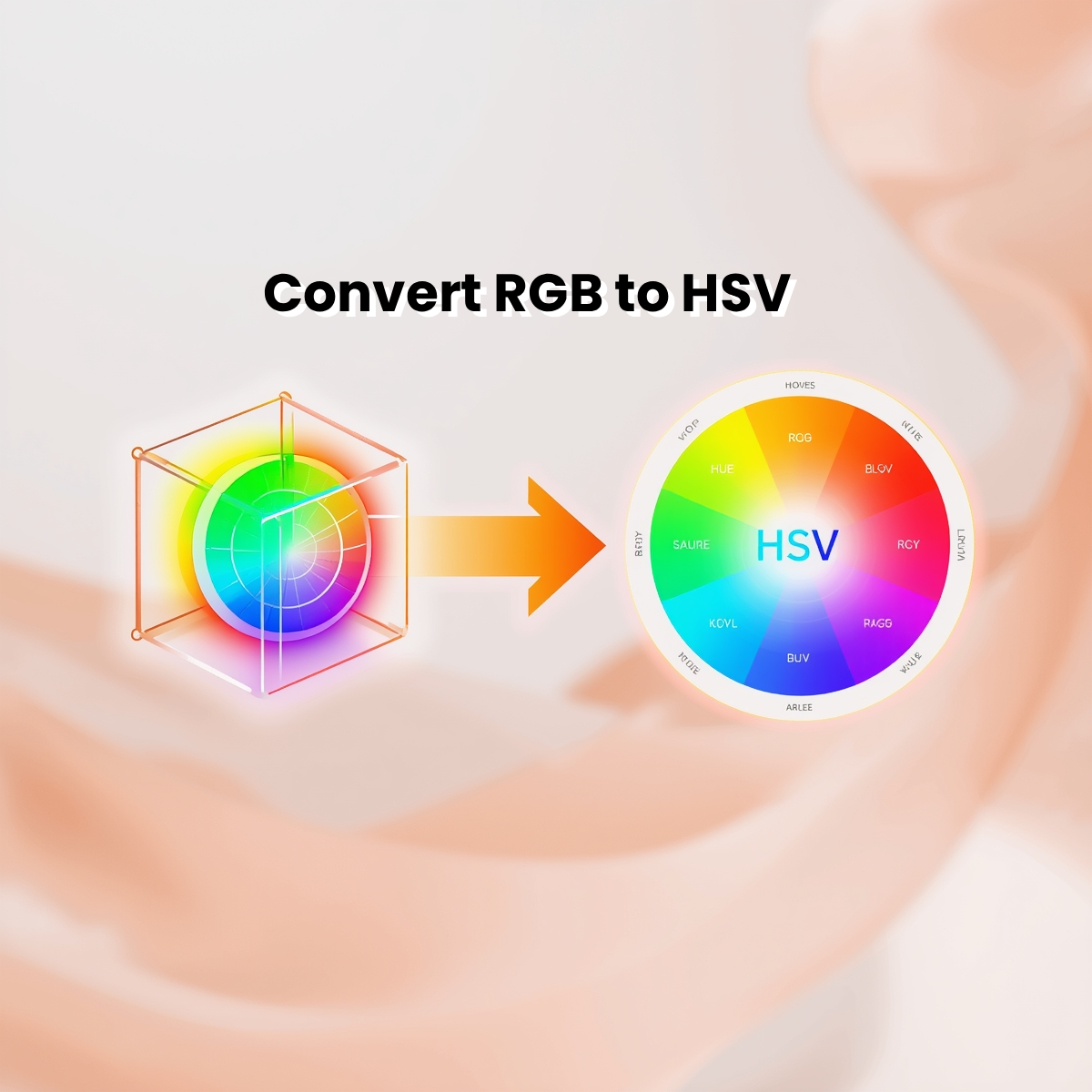
HSV stands for Hue, Saturation, and Value. It is a cylindrical representation of points in an RGB color model. While RGB is more technical and focused on the screen display, HSV is closer to how humans perceive colors.
- Hue represents the type of color (such as red, green, blue) and is measured in degrees from 0 to 360.
- Saturation refers to the vibrancy or purity of the color.
- Value (also called brightness) defines how light or dark the color appears.
The HSV model is widely used in image editing tools, color pickers, and digital painting software because it makes color manipulation more intuitive.
Why Convert RGB to HSV?
There are several reasons for needing an RGB to HSV conversion:
- User Interface Design: Adjusting hue and saturation is easier than tweaking RGB values for color consistency.
- Image Processing: Many algorithms work better in HSV because it separates color intensity from color type.
- Machine Learning and Computer Vision: HSV allows better detection of objects or regions based on color.
Thus, being able to convert RGB to HSV gives developers and designers more control over how colors behave in different contexts.
RGB to HSV Conversion Formula
RGB HSV transformation is defined as a mathematical computation of red, green and blue values into hue, saturation and value.
This is the simplified version of the way to transform RGB to HSV:
Normalize the RGB values dividing each by 255.
Find out the maximum and minimum value of R, G and B.
Value (V): Max of the normalized R, G, and B.
Compute Saturation (S): When max = 0, S = 0; when this is not the case, S = (max – min) / max.
Compute Hue (H) according to what colour channel is the highest:
When the max = R then H = 60( (G – B)/(max – min)) mod 6
Should max = G, then to calculate H we have H = 60 ((B R)/(max min)) + 2
In case that max = B, then H = 60((R -G)/(max – min)) + 4
and the last output is the three H (0360), S (01), and V (01) which can be transformed into a percentage should that be necessary.
RGB vs HSV vs HSB: What's the Difference?
Some tools and platforms refer to HSV as HSB, which stands for Hue, Saturation, Brightness. In practical terms, RGB to HSB and RGB to HSV are the same thing just different naming conventions. Many software applications (like Adobe Photoshop) use HSB, while scientific or programming contexts typically use HSV.
So if you’re trying to convert RGB to HSB, you’re essentially performing an RGB to HSV conversion.
Tools to Convert RGB to HSV
There are many online tools and libraries that help with RGB HSV conversion. Whether you’re working in Python, JavaScript, or design software, the conversion is usually built-in or available through packages.
Some examples include:
- Python (colorsys module)
- JavaScript (custom functions or libraries like chroma.js)
- Online color pickers and converters
These tools ensure that even incorrect variations like rbg to hsv or hext to rgba are usually auto-corrected, offering seamless conversion. You can also use our RGB to HSL Converter when you need to switch between RGB and HSL values while working on UI colors, CSS effects or digital design adjustments.
Final Thoughts
The process of converting RGB to HSV plays an important part in the life of every color manager and user interface and experience designer or media owner. Along with the properties of color like hue and brightness the RGB HSV model lets it be manipulated in a more intuitive way thus creating more pleasant and consistent designs a lot more easily.
You might be struggling to convert RGB to HSB within a design program or using RGB to hue saturation values in your code either way, learning this conversion allows you to better understand how to work with color.
What’s the main difference between RGB and HSV?
RGB is a technical model used for screens, while HSV aligns more with human color perception. HSV separates color (hue) from its brightness (value) and intensity (saturation).
Are HSV and HSB the same?
Yes, they are essentially the same. HSB stands for Hue, Saturation, Brightness, which corresponds to the Hue, Saturation, and Value in HSV.
How can I convert RGB to HSV manually?
You can use a mathematical formula to convert RGB values (0–255) into HSV values by normalizing RGB, finding the min and max, and calculating hue, saturation, and value accordingly.
Is there any tool to help with RGB HSV conversion?
Yes, you can find many free online tools, as well as use code libraries like Python’s colorsys or JavaScript libraries like chroma.js.
Why do designers prefer HSV over RGB?
HSV makes it easier to adjust the color’s tone and intensity, which is useful for creating consistent palettes or theme designs.
What is the easiest way to convert RGB to hue saturation values?
Use a color picker tool or a built-in function in your design software or programming language to extract hue and saturation directly from RGB values.
How can I convert HSV to RGB?
To convert HSV to RGB, use the hue, saturation, and value to calculate the red, green, and blue components. For an easy and fast option, you can also use our HSV to RGB Converter.