

Checker Tools
Text Tools
- Text separator
- Email extractor
- URL extractor
- Text size calculator
- Duplicate lines remover
- Text to speech
- IDN Punnycode converter
- Case converter
- Character counter
- List randomizer
- Reverse words
- Reverse letters
- Emojis remover
- Reverse list
- List alphabetizer
- Upside down text generator
- Old English text generator
- Cursive text generator
Developer Tools
Generator Tools
Image manipulation tools
- BMP to ICO
- ICO to JPG
- ICO to GIF
- ICO to PNG
- ICO to WEBP
- ICO to BMP
- GIF to JPG
- GIF to ICO
- GIF to PNG
- GIF to WEBP
- GIF to BMP
- HEIC to PNG
- HEIC to GIF
- HEIC to JPG
Powerful Kelvin to Celsius Converter Guide
Kelvin to Celsius
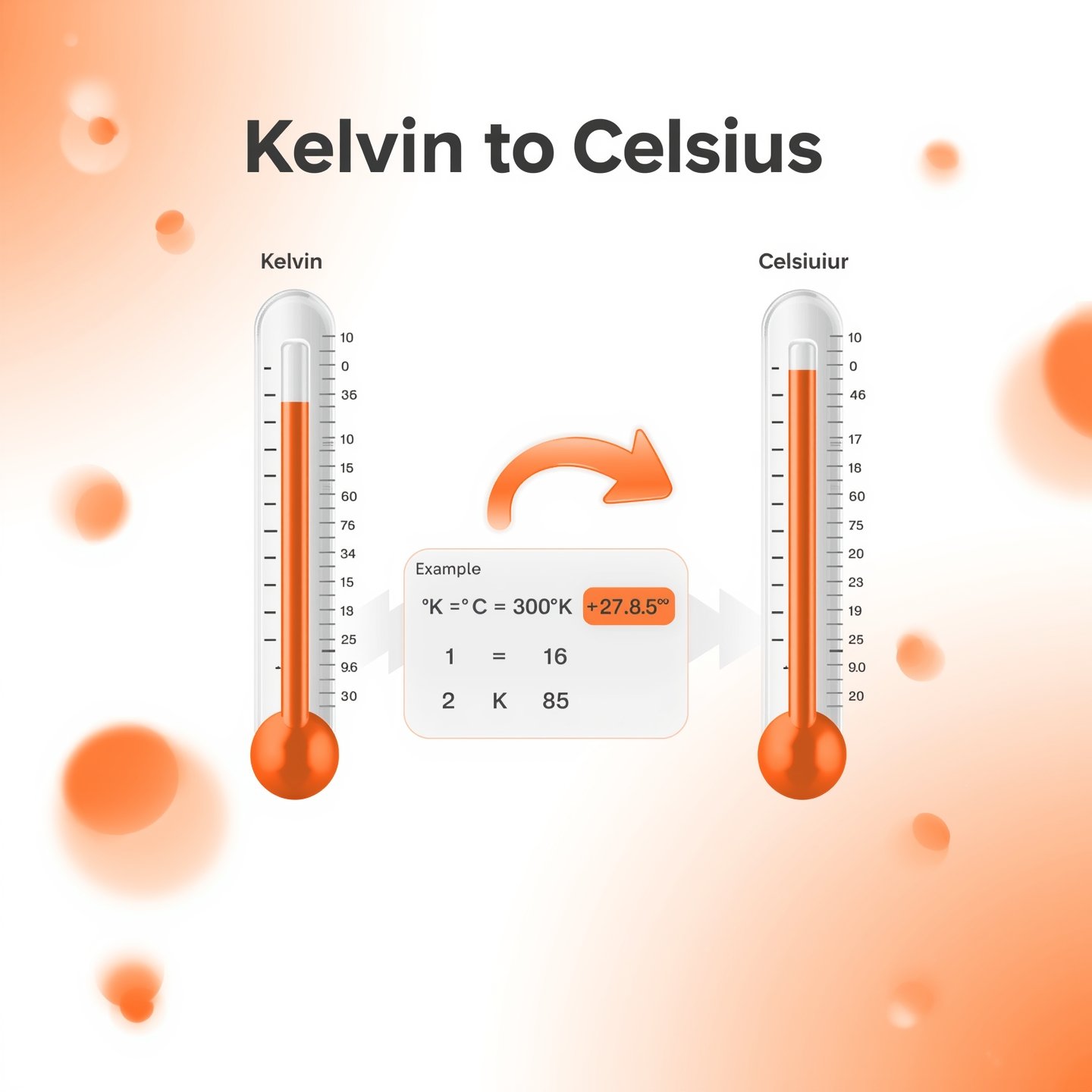
Temperature measurement is a very important issue in many aspects including physics, chemistry, meteorology, and in day to day life. Although Celsius is used by most people on a daily basis to give reports on typical weather and climate, Kelvin is most common in the scientific world as a unit of measure of temperature. The conversion of Kelvin to Celsius is not only relevant to students or professionals alone, but any person engaged in dealing with scientific data. This guide will tell how to convert Kelvin to Celsius, Kelvin to Celsius formula, and the frequently asked questions about converting temperature between Kelvins and Celsius.
What Is the Difference Between Kelvin and Celsius?
Before proceeding with how to change Kelvin to Celsius it is important to know what the two units of measure represent. Kelvin scale originates at the absolute zero; the molecular movement halts theoretically. This scale does not refer to anything that has the title of degrees and thus it distinguishes itself with Celsius or Fahrenheit.
On the other hand, the Celsius scale (otherwise named centigrade), pegs the freezing point of water to 0 C and the boiling point to 100 C. Both scales have the same increment in a magnitude i.e. every kelvin is implied to be equal to one degree Celcius.
Kelvin to Celsius Formula
The Kelvin to Celsius formula is incredibly simple:
Celsius = Kelvin – 273.15
This is the standard Kelvin to degree Celsius conversion used across all scientific disciplines. Whether you’re dealing with high-energy particle physics or basic weather forecasts, this formula remains the same.
How to Convert Kelvin in Celsius: Examples
Let’s look at a few practical examples to understand the K to C conversion better:
- 300 K → 300 – 273.15 = 26.85°C
- 0 K → 0 – 273.15 = -273.15°C
- 273.15 K → 273.15 – 273.15 = 0°C
These examples show how easy it is to convert K to C using the formula.
K to Degrees C: The Scientific Importance
In many laboratory settings, researchers frequently switch between Kelvin and Celsius. For instance, when analyzing gas laws, experiments must often begin at Kelvin values but report findings in degrees Celsius for public readability. Understanding the Kelvin to Celsius equation is vital in such cases.
Whether you’re calibrating sensors or interpreting climate models, K to C knowledge is foundational.
Kelvin to Centigrade Formula in Simple Terms
Many still refer to Celsius as centigrade, especially in European or educational materials. The Kelvin to centigrade formula is no different:
Centigrade = Kelvin – 273.15
So if you’re searching for a Kelvin centigrade converter, remember: it’s just another name for the same thing.
How Do You Convert Kelvin into Celsius?
What is interesting, however, is how do we turn Kelvin to Celsius in real-life application? It is as simple as using a calculator or even a simple math even mentally. Strike off 273.15 in any Kelvin reading and you have your Celsius reading. That’s it!
It applies to any values, be it the study of climatic data or even simulating thermodynamic responses or plain curious about Kelvin Celsius relationships
Convert K to C Using Online Tools
If manual calculation isn’t your thing, you can use a Kelvin to Celsius converter online. These tools are ideal for quickly finding Kelvin to degree Celsius conversion for multiple values or unusual decimals. Just enter the value in Kelvin, and the site instantly displays the Kelvin to C result.
Common Uses of Kelvin and Celsius
- Scientific Research: Kelvin is preferred in high-precision experiments and calculations.
- Daily Use: Celsius is more common in weather forecasts and cooking.
- Engineering: Many engineers use both scales interchangeably, depending on the context.
So, whether you’re dealing with cryogenics or boiling water, understanding how to convert K to Celsius is a useful skill.
Final Thoughts
Kelvin to Celsius conversion is a necessary topic to understand whether you are a student, researcher, or any other passionate learner. With the simple formula of K to C it is very easy to change any temperature in Kelvin to Celsius or degree Celsius, or centigrade by merely stripping 273.15 off the temperature in Kelvin.
The knowledge makes reading scientific reports, understanding weather charts or other such things all the easier and again, this comes to show that even the most complex of things can be handled with the right set of technology and knowledge.
And so the next time you roll across a value in Kelvin you will be able to handle converting K to C thanks to this whole tutorial.
Q: Is 0 K equal to 0°C?
No. 0 Kelvin equals -273.15°C, which is absolute zero the lowest possible temperature.
Q: How do you convert K to C manually?
Simply subtract 273.15 from the Kelvin value. This gives you the temperature in Celsius.
Q: How do you convert Celsius to Kelvin?
Just add 273.15 to the Celsius value. Try our Celsius to Kelvin converter for quick results.
Q: Why is Kelvin used in science instead of Celsius?
Kelvin starts at absolute zero, making it ideal for precise scientific measurement without dealing with negative numbers.
Q: Is there a difference between Celsius and Centigrade?
No. Celsius and Centigrade are two names for the same temperature scale.
Q: Can you go below 0 Kelvin?
No. 0 K is absolute zero, the theoretical lowest temperature possible.